The commons leak: what a free rider costs your energy community
In the simulated energy community, a free rider under an open pool draws a net 363 kWh per year more from the shared battery than a regular participant. Pro-rata contribution rules halve that to 204 kWh; under pricing with graduated sanctions, free riders pay for it and adjust. Rules are not paperwork: a load-shifting agreement alone lifts self-consumption from 38.7 to 40.1%.
Three rule sets, one neighbourhood
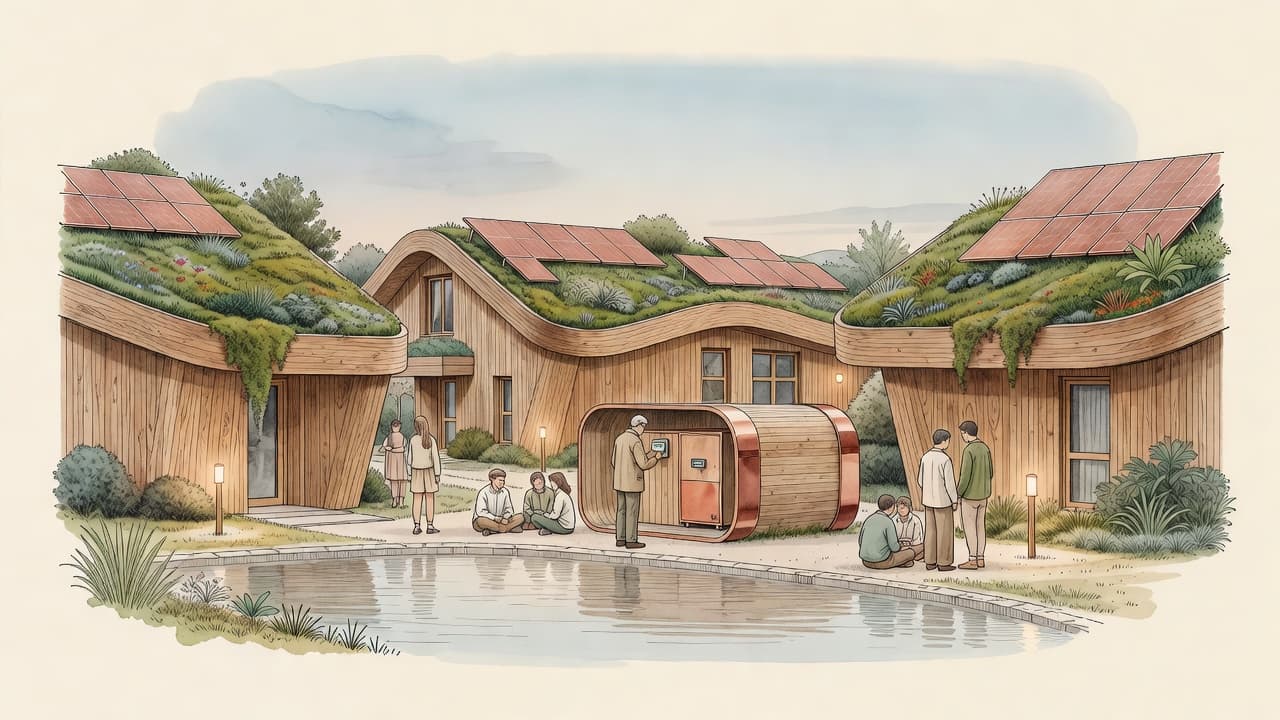
Image above: AI impression, not a construction drawing.
Since July 2026, European households have a legal right to energy sharing. That means thousands of new energy communities face the same question this year: how do we divide what the shared installation produces? And almost nobody has an instrument to test sharing rules in advance.
The lab now has a community layer for exactly that: simulated households with different consumption styles, and three sharing rule sets you can compare side by side, inspired by the design principles of Nobel laureate Elinor Ostrom. An open pool where everyone draws freely from the shared battery. Pro-rata contribution, where your entitlement grows with what you put in. And a variant with pricing and graduated sanctions.
Same neighbourhood, same physics, three sets of agreements. Only the rules differ.
The leak, quantified
Finding the right metric was half the work. A free rider's advantage in euros gets polluted by differences in consumption; only the net battery draw, what someone takes from the commons minus what they put in, isolates the effect of the rules themselves.
With that metric, the leak becomes visible:
- Open pool: a free rider draws a net 363 kWh per year more from the shared battery than a regular participant.
- Pro-rata contribution (Ostrom's second principle: benefits proportional to contributions) halves that to 204 kWh.
- Pricing with sanctions reverses it: free riders pay for their behaviour, and in the model they adjust it accordingly. Graduated sanctions work.
So the leak is not a moral question but a design variable. A community can put a number on it before signing the statutes.
Rules also create physical value
The most surprising result sits on the other side of the ledger. Governance does not only distribute, it produces.
A load-shifting agreement alone, households moving part of their flexible consumption into solar hours, lifts the neighbourhood's self-consumption from 38.7 to 40.1%. That is physical value, in kilowatt-hours that no longer need to travel to the grid and back, created by nothing more than an agreement.
The core of credible governance simulation is a strict separation: behaviour changes demand, rules change distribution. The first is measurable in kilowatt-hours, the second in euros and fairness. Tools that mix the two produce stories you cannot falsify; the lab guards the separation with a fixed check that tells accounting errors apart from physics errors.
What this leans on
The biggest caveat of this layer is also its agenda: the behavioural profiles of the simulated households are design choices, labelled and adjustable, but not yet calibrated on measured behaviour of real energy communities. Every result above therefore deserves the qualifier: in the model.
What stands is the shape of the answer. Sharing rules have a measurable effect on who benefits from a shared installation, and that effect can be simulated in advance instead of discovered afterwards in a soured members' meeting.
For every community sharing a battery under the new energy-sharing right this year, that is the real message: do not choose your rules on gut feeling. Run the numbers.